
Act · For Policymakers
Policy can turn new PPH evidence
into routine care.
This page provides a fundable, sequenced package for ministries, professional bodies, funders, and programme leads.
Approximately 43,000 women die annually from postpartum haemorrhage, averaging one death every 12 minutes. These deaths mainly occur in regions with weaker healthcare systems[1]. A study involving 80 hospitals across four African countries demonstrated that calibrated measurement and a bundled first response cut severe haemorrhage, laparotomy, and bleeding-related deaths by 60% [2], with proven cost-effectiveness in trial conditions [3]. From October 2025, the unified WHO–FIGO–ICM guidelines establish the global standard for managing postpartum haemorrhage [4]. What remains is adoption.
The package
Five levers
Each lever links to the page that evidences it.
01
Align the national definition. Identify a loss of ≥300 mL combined with any abnormal vital sign, or a loss of ≥500 mL by itself, and respond accordingly. [4].
02
Make objective measurement routine. Visual estimation fails in 52% of cases, while calibrated measurement misses only 7%. Integrate measurement into procurement, birth records, and digital systems. [4].
03
Fund the first-response bundle as one pathway. Commodities, training, authority, and audit are listed as a single line item; partial adoption fails to achieve the intended effect. [2].
04
Give frontline teams authority to act. Midwives and all birth attendants authorised to deliver every bundle component without waiting for permission [4].
05
Treat anaemia as PPH prevention. Antenatal haemoglobin testing and treatment represent the most impactful upstream investment.
The standard
The PPH-readiness standard
Adoption is assessable at three levels, and each level has a short, auditable list.
National alignment:
Learning system:
Audit with feedback to units includes indicators that measure time intervals such as birth to recognition, trigger to bundle, and call to blood. Additionally, it involves a standing review that investigates where delays are occurring, rather than only whether outcomes have changed. [6].
Anticipate the objection
Anticipate the objection
When objective measurement is implemented, postpartum haemorrhage rates recorded will increase because previously unnoticed cases become visible. This increase reflects better detection, not declining care, and it’s important to communicate this clearly to boards, ministries, and the media before the first post-implementation audit. [6]. The crucial endpoint is not just the recorded rate but the decrease in missed haemorrhage, severe postpartum haemorrhage, transfusions, surgeries, and deaths.
The honest economics
The honest economics
The alongside-trial evaluation demonstrated that the pathway is cost-effective within the trial context. The adjusted cost difference was US$0.30 per patient, which translates to approximately US$11.83 per severe PPH case prevented and US$113.91 per Disability-Adjusted Life Year (DALY) averted, both of which are below the benchmark thresholds for these countries [3]. When willingness-to-pay thresholds surpass about US$1,500 per DALY averted, the likelihood of cost-effectiveness exceeds 80% [3]. Costs and thresholds vary across countries; therefore, combine this evidence with a local budget impact analysis before making funding decisions.
The barriers are already mapped
The barriers are already mapped
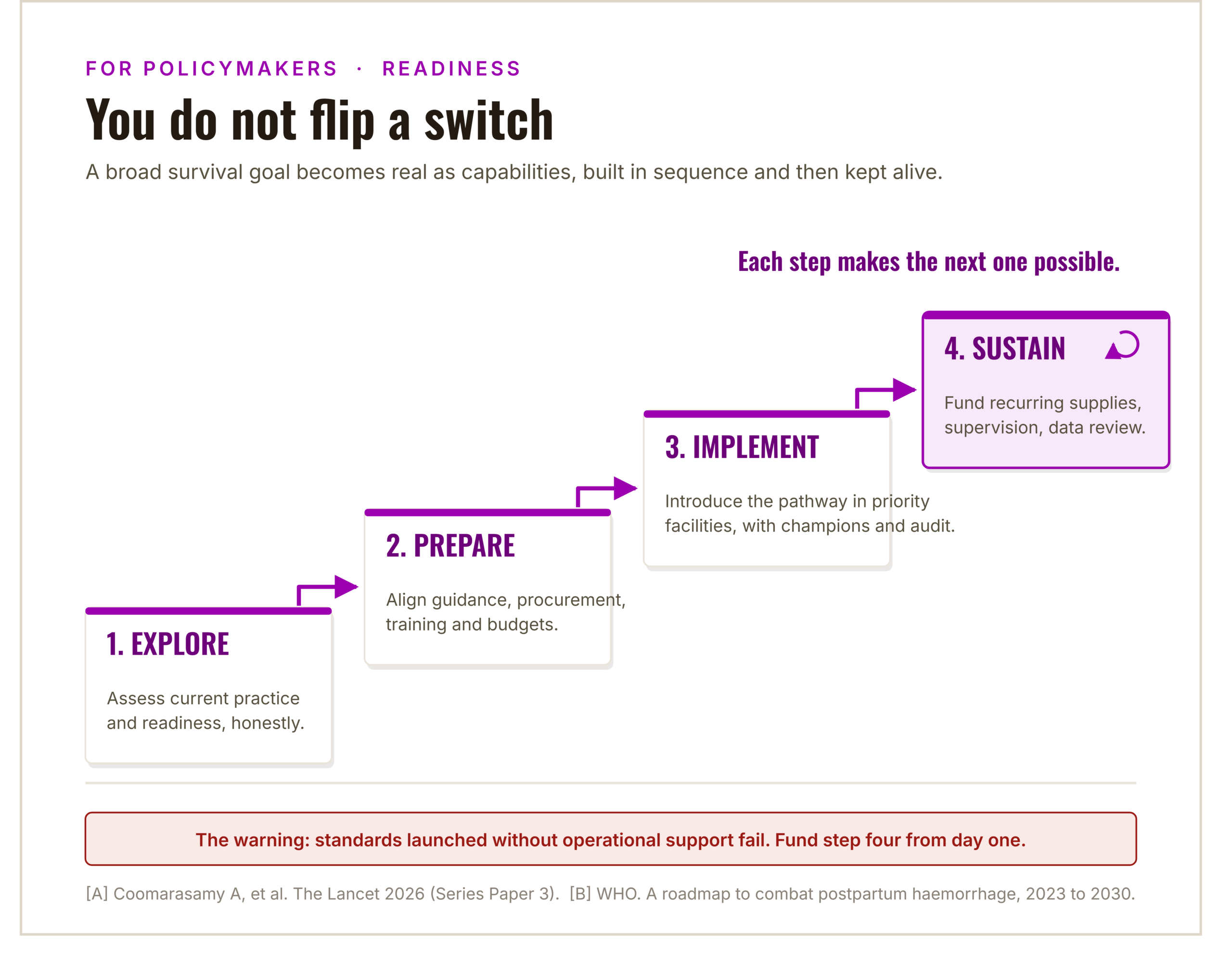
A mixed-methods study involving 102 global stakeholders, 246 health workers, and 2,039 direct observations identified specific failure points in implementation, including procurement, medicine and device availability, their affordability and quality, the presence of job aids, and the availability of qualified staff [7]. The study concludes that effective sequencing is crucial, as addressing only one aspect of the implementation system is unlikely to produce transformative change [7].
References
[1] Coomarasamy A, Sindhu KN, Gallos I, et al. Postpartum haemorrhage: epidemiology, consequences, and missed opportunities. The Lancet, 2026. Paper · DOI
[2] Gallos I, Devall A, Martin J, et al. Randomized Trial of Early Detection and Treatment of Postpartum Hemorrhage (E-MOTIVE). New England Journal of Medicine, 2023;389:11–21. Paper · DOI
[3] Williams I, et al. A cost-effectiveness analysis of early detection and bundled treatment of postpartum hemorrhage alongside the E-MOTIVE trial. Nature Medicine, 2024;30:2343–2348. Paper · DOI
[4] WHO, FIGO, ICM. Consolidated guidelines for the prevention, diagnosis and treatment of postpartum haemorrhage, 2025. Paper
[5] Gallos ID, Sindhu KN, Yunas I, et al. Prevention of postpartum haemorrhage: from evidence to implementation at scale. The Lancet, 2026. Paper · DOI
[6] Coomarasamy A, Devall AJ, Bell S, et al. Diagnosis and treatment of postpartum haemorrhage: a race against time. The Lancet, 2026. Paper · DOI
[7] Williams CR, et al. Barriers and bottlenecks to implementation of WHO recommendations for prevention, detection, and treatment of postpartum hemorrhage: a mixed-methods triangulation study. Implementation Science Communications (in press). Paper